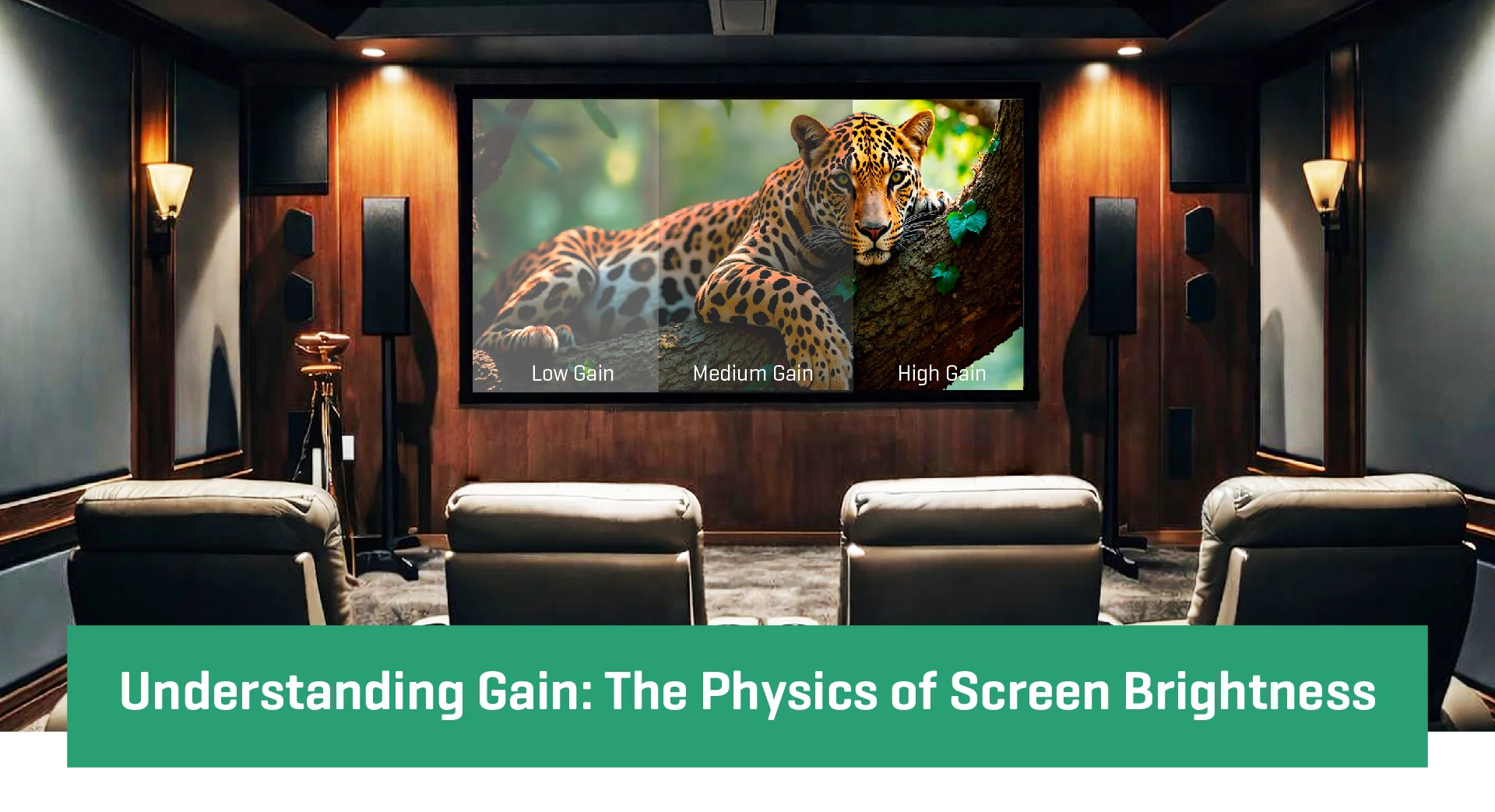
When selecting a projection screen, most buyers focus on size, resolution, or frame design. But one technical factor directly impacts what you actually see on the screen: Gain.
At Lumina Screens, we believe understanding screen gain helps you make informed decisions—whether you are an AV integrator, dealer, architect, or home theater enthusiast.
Let’s break down the science behind it.
What Is Screen Gain?
Screen gain is the ratio that shows how much light a projection screen reflects back to the viewer; for example, if it reflects 100% light the gain is 1.0, and if it reflects 120% light the gain is 1.2.
- Gain 1.0 → Neutral brightness (reflects light evenly)
- Gain above 1.0 → Brighter image, more focused reflection
- Gain below 1.0 → Softer brightness, wider viewing angles
In simple terms:
Gain determines how bright the projected image appears from the viewer’s seating position.
The Physics Behind Gain
Screen gain is governed by light reflection principles.
There are two primary types of reflection:
1. Diffuse Reflection
Light scatters uniformly in all directions.
- Wide viewing angles
- Balanced brightness
- Natural color reproduction
This is typical of matte white screens with a gain of around 1.0.
2. Specular Reflection
Light is directed more toward a specific viewing axis.
- Higher brightness at center
- Narrower viewing angle
- Potential hotspotting
Higher gain screens (typically 1.2 and above) use this principle.
Why Gain Matters in Real Environments
The correct gain depends on three major factors:
1. Projector Brightness (Lumens)
- High-lumen projector → Projection distance is less → Lower gain screens work well
- Low-lumen projector → Projection distance is more → Higher gain screens may be required
2. Ambient Light Conditions
- Controlled dark room → You can use 1.0 to 1.4 gain screens, depending on the brightness level you want in the image.
- Bright room → Use an ALR screen with gain between 0.8 to 1.5, depending on the contrast and brightness you want to achieve.
3. Viewing Angle
- Wider seating layout → Moderate or lower gain recommended
- Focused central seating → Higher gain acceptable; curved screens can also help maintain brightness across the viewing area
Gain and ALR Technology
Modern screens go beyond simple brightness enhancement.
Lumina’s ALR – Leor Series and Leor UST fabrics are designed to:
- Reflect projector light efficiently
- Reject ambient light from ceilings and side walls
- Preserve contrast in bright environments
Unlike traditional high-gain screens, ALR technology improves perceived contrast and brightness while minimizing hotspotting.
Common Gain Ranges Explained
Let’s consider you have a medium-lumen projector and the projection distance is medium. Based on the room lighting and screen type, the gain can be selected as follows:
| Room Lighting | If You Choose Gain | Brightness Impact |
| Dark room | 1.0 (White Screens) | Natural and uniform brightness |
| Dark room | 1.1 – 1.4 (White Screens) | Brighter image |
| Mild ambient light | 1.2 – 1.5 (ALR Screens) | Brighter image while maintaining contrast |
| High ambient light | 0.8 – 1.0 (ALR Screens) | Moderate brightness with deeper contrast |
The Myth: Higher Gain = Better Screen
Not always.
While higher gain increases brightness, it can:
- Reduce viewing angles
- Create uneven brightness (hotspots)
- Affect color accuracy
The right gain is about balance, not maximum brightness.
How Lumina Screens Engineers the Right Gain
At Lumina Screens, we manufacture screen fabrics engineered for specific use cases:
- Leor Series (ALR) – Optimized for bright living spaces
- Leor UST – Designed for Ultra Short Throw projectors
- Leor Black – Enhanced contrast performance
- Color Pro White – Reference-level color neutrality
- Accupix – Acoustic transparent precision
Each fabric is engineered to deliver optimal brightness distribution while preserving viewing angles and color fidelity.
Final Thought: Brightness Is Science, Not Guesswork
Screen gain isn’t just a number on a specification sheet—it’s a fundamental optical property that determines image performance.
Choosing the right gain ensures:
- Accurate colors
- Balanced brightness
- Comfortable viewing
- Maximum projector performance
When paired correctly, the projector and screen work as a unified visual system.
If you’re selecting a projection screen and unsure about gain requirements, consult with Lumina’s experts. The right surface makes all the difference.
Lumina Screens
Precision-engineered viewing experiences.
- Date - March 13, 2026