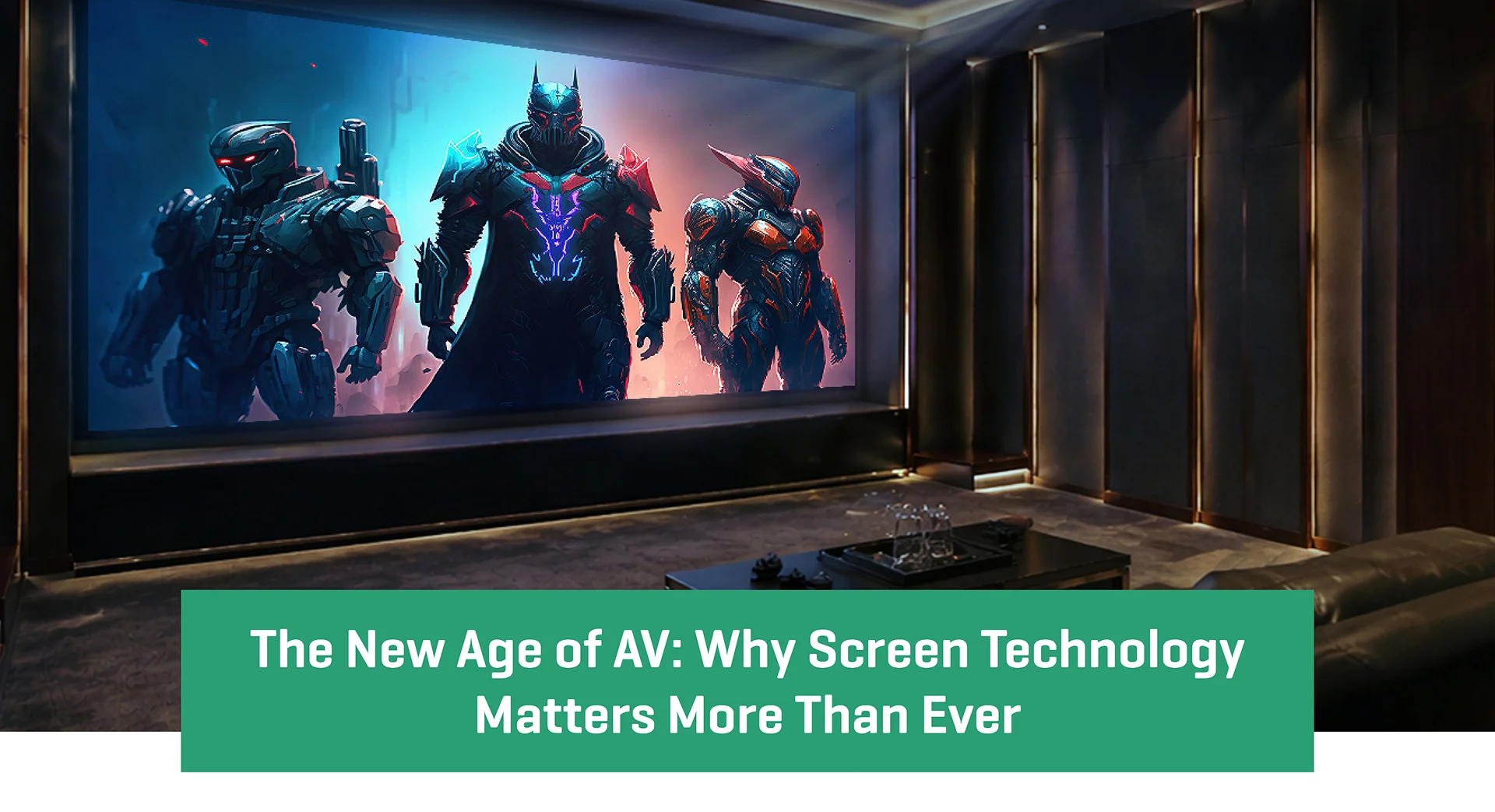
The audiovisual (AV) industry is witnessing rapid growth, driven by evolving consumer expectations and technological advancements. From home cinemas and corporate boardrooms to simulation environments and experience centers, the demand for high-performance visual experiences is at an all-time high.
In this transformation, one element plays a defining role in delivering true performance: the projection screen.
The Shift Toward Larger and Smarter Displays
Large-format displays are becoming the new standard across industries. Users today expect immersive, cinematic visuals that go beyond traditional setups.
This shift is powered by high-lumen projectors that deliver brighter images even in ambient light, along with ultra-short throw (UST) technology that enables large screen sizes in compact spaces.
However, advanced projection requires equally advanced screen technology to deliver its full potential.
The Rise of Specialized Screen Surfaces
Modern AV environments demand screens that are engineered for performance.
Ambient Light Rejection screens are critical in spaces where lighting cannot be fully controlled. Surfaces like Lumina’s Leor Series (ALR) are designed to enhance contrast and clarity by rejecting ambient light and reflecting projected light effectively.
With the growing adoption of UST projectors, surfaces such as Leor UST ensure uniform image quality and eliminate distortion, making them ideal for contemporary installations.
These are no longer optional upgrades. They are essential for achieving optimal visual output.
Customization Is the New Standard
Studios, corporate spaces, and experience centers are increasingly moving toward customized large-format displays.
From curved installations to wall-to-wall screens, the focus is on seamless viewing and precision. Standard solutions often fall short in such environments.
Lumina’s Color Pro White and Leor Black surfaces are designed to support customized applications where uniformity, depth, and accuracy are critical.
Every installation today demands attention to detail, from material selection to execution.
The Integration of Audio and Visual
Immersive experiences are no longer just visual. Audio plays an equally important role.
Acoustically transparent screens are becoming a preferred choice, allowing speakers to be placed behind the screen without compromising sound quality.
Lumina’s Accupix acoustic transparent screens are engineered using micro-perforated and woven technologies, enabling seamless integration of sound and visuals while maintaining image integrity.
This approach creates a cleaner setup and a more natural viewing experience.
The Future Is Immersive
The growth of immersive content across gaming, simulation, virtual production, and experiential spaces is redefining AV expectations.
Screens are no longer passive display surfaces. They directly influence brightness, contrast, color accuracy, and sound alignment.
The Lumina Advantage
At Lumina Screens, we design solutions that align with modern AV requirements. From ALR and UST-compatible surfaces to acoustically transparent technologies, our products are built to complement the latest projection systems.
Because in today’s AV landscape, the screen is not just a surface. It is an experience.
- Date - April 22, 2026