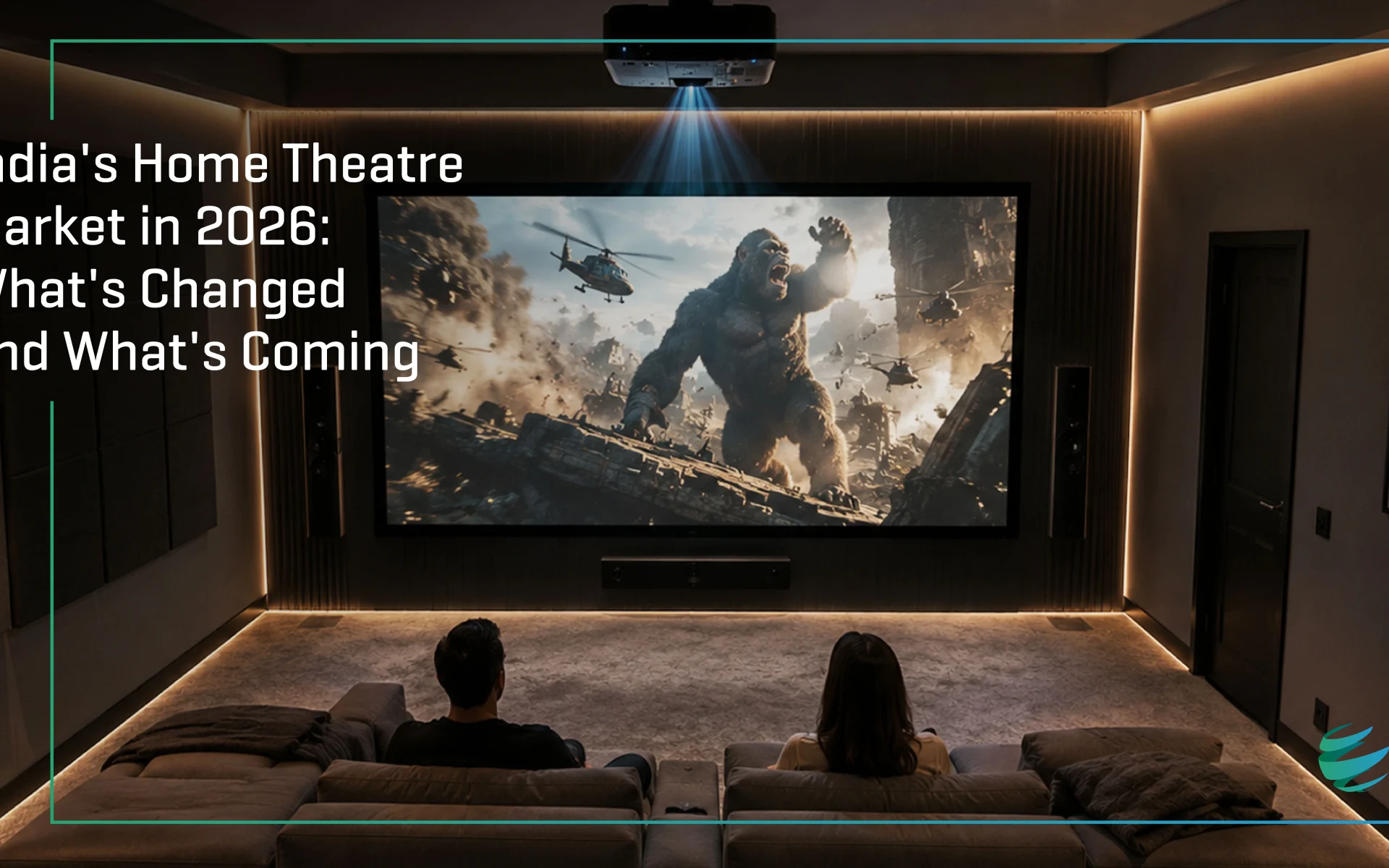
How streaming, smaller cities and smarter screens are rewriting the Indian home cinema story
A few years ago, a home theatre in India meant a soundbar, a big TV and a proud Diwali-weekend purchase. Walk into homes across Mumbai, Ludhiana or Vijayawada today and the picture looks different: families are pulling down projector screens, not just switching on televisions, and the “home theatre” conversation has moved well past the metros. 2026 is turning out to be a genuine inflection point for India’s home entertainment market — here’s what’s changed, and where it’s headed next.
The Big Shift: Projectors Are No Longer a Metro-Only Luxury
For years, projector-based home theatres were seen as a premium, urban indulgence. That’s changing fast. Industry reports through 2026 point to home entertainment spreading into smaller cities and even rural households — from farming families in Punjab setting up big-screen viewing for IPL nights, to culturally cinema-first states like Andhra Pradesh bringing the theatre experience home. Brightness, auto-alignment and simpler setups have removed the technical barrier that once kept projectors in the hands of hobbyists and AV professionals alone.
Industry leadership is backing this shift with real numbers: BenQ’s India leadership has projected the domestic home projector market to roughly double by 2029, growing at 20–25% annually, as more households choose to “make their home a multiplex” rather than compete with large-format smart TVs on price alone.
Market Size: Steady, Broad-Based Growth
India’s home theatre projector segment was estimated at roughly USD 287 million in 2025, holding an 18% share of the wider Asia-Pacific market and growing at close to 8% a year — among the fastest growth rates in the region. Asia-Pacific as a whole is projected to be the largest regional block globally through 2026, with India and China cited as the primary engines behind that growth, driven by rising disposable incomes and a cultural appetite for shared, large-screen viewing.
What’s notable is where the growth is coming from. It isn’t only premium, dedicated cinema rooms in villas — a meaningful share is mid-market: living rooms doing double duty as theatres, budget and mid-range projectors under ₹40,000, and screens sized to match.
What’s Changed in the Product Itself
Why the Screen Has Become the Real Differentiator
Here’s the trend that matters most for anyone shopping for a home theatre in 2026: the projector used to be the headline purchase, and the screen was an afterthought — often just a bare wall. That’s no longer good enough. Bare walls crush contrast and dull colour accuracy, and buyers are noticing the difference a proper screen makes.
Demand has shifted decisively toward larger, motorized and frameless projector screens that retract into a wall or ceiling when not in use, finished in wider aspect ratios and ambient-light-rejecting surfaces built for real living rooms — not just dark, dedicated cinema rooms. Screens have moved from a functional accessory to a design element that interior designers now plan around from day one.
For most Indian buyers, the smart move is treating the screen and projector as a matched pair rather than two separate purchases — checking throw distance, gain, and light rejection together rather than assuming any flat surface will do.
What a 2026 Home Theatre Budget Actually Looks Like
Prices have moved up 8–12% since 2024 on the back of rupee depreciation, higher import duties on AV electronics and premium brand revisions — but the entry point has also come down, thanks to compact, budget-friendly projectors. Broadly, Indian buyers in 2026 are landing in three tiers:
What’s Coming Next
The Takeaway for Indian Home Theatre Buyers
India’s home theatre story in 2026 isn’t just about bigger projectors — it’s about smarter, more complete setups reaching a much wider audience, from metro apartments to small-town living rooms. As the market matures, the screen is no longer the last thing you buy; it’s the piece that decides whether the rest of your setup actually looks the way it should.
At Lumina Screens, we design projector screens for exactly this shift — built for real Indian living rooms, real ambient light, and the kind of everyday big-screen moments this market is increasingly built around.
Sources
Market-size, growth-rate and technology-share figures are drawn from industry market-research publishers; treat them as directionally credible rather than precise, as methodology isn’t independently audited. The BenQ growth projection is the strongest data point, being a named-executive statement rather than a syndicated estimate.
1. “India’s home projector market set to double by 2029, South and West lead the surge: BenQ MD”
madhyamamonline.com/business/indias-home-projector-market-set-to-double-by-2029-1410345
2. “Home Theater Projector Market Size Forecast | CAGR of 7.56%” — Industry Research Biz.
industryresearch.biz/market-reports/home-theater-projector-market-106576
3. “Why Bharat Is Skipping Big TVs for Projectors: Inside India’s New Big-Screen Obsession Beyond Metros” — Open Magazine. openthemagazine.com/branding-marketing-and-advertising/the-big-screen-shift-why-bharat-is-skipping-tvs-for-projectors
4. “Projector Screen Market Size, Share & YoY Growth Rate, 2032” — Coherent Market Insights.
coherentmarketinsights.com/market-insight/projector-screen-market-2527
5. “Home Theater Projectors Market Size, Growth & Forecast [2034]” — Verified Market Reports.
verifiedmarketreports.com/product/home-theater-projectors-market
6. “Home Theater Projector Market 2026 | 2035” — Business Research Insights.
businessresearchinsights.com/market-reports/home-theater-projector-market-122232
7. “Home Theatre Projectors Market Size, Growth, Forecast Till 2031” — ReportPrime.
reportprime.com/home-theatre-projectors-r2636
8. “Home Theatre Packages Cost in India 2026” — NanoTheatre.
nanotheatre.com/home-theatre-packages-in-india
- Date - August 21, 2026