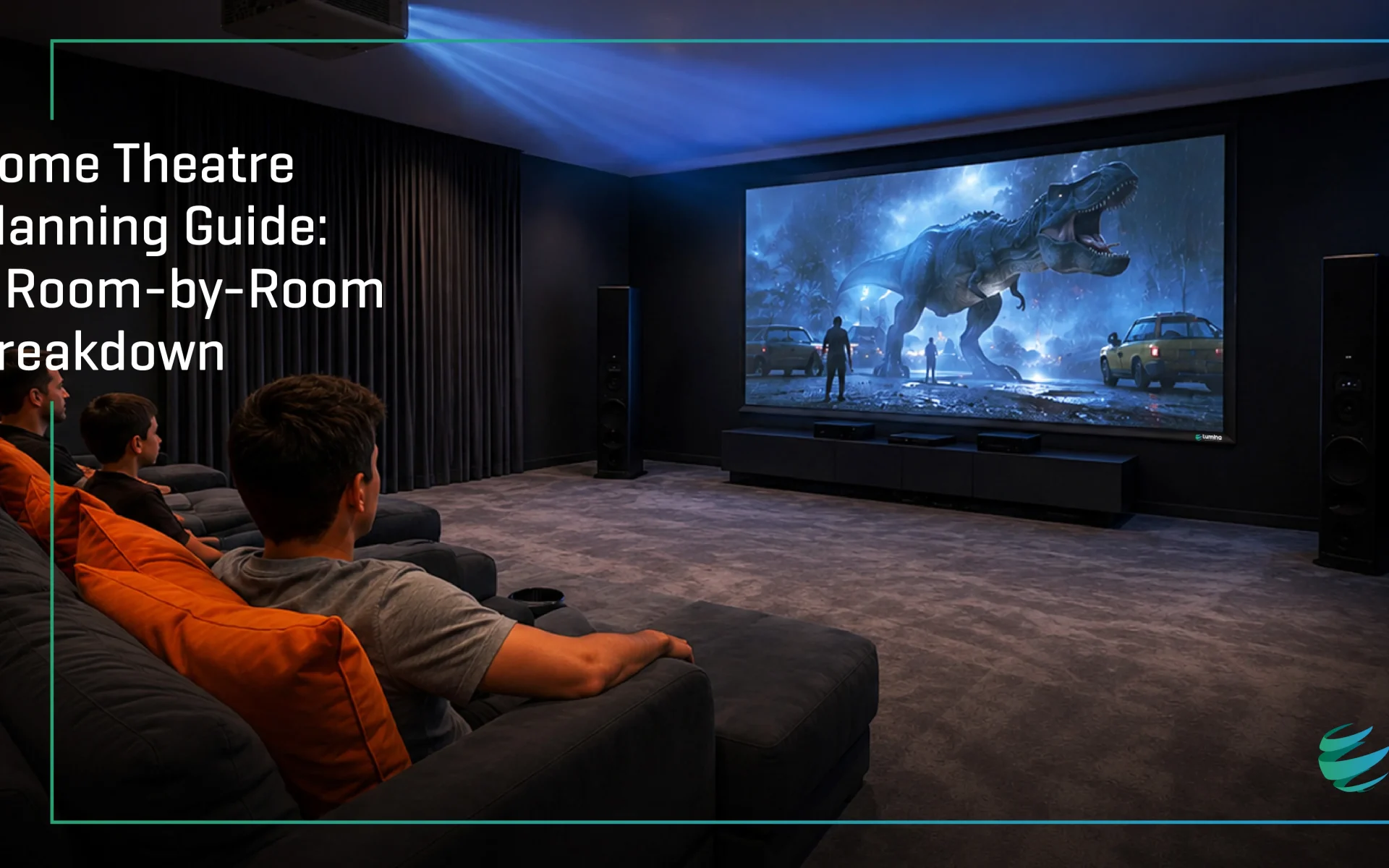
Whether you’re converting a spare bedroom, finishing a basement, or designing a dedicated cinema room from scratch — this guide walks you through what to plan, what to prioritise, and what most people get wrong.
Building a home theatre is one of the most rewarding upgrades you can make to your home. It’s also one of the easiest to get wrong.
Most buyers start with the projector or the TV. They spend weeks comparing specs, lumen counts, and contrast ratios. Then — as an afterthought — they pick a screen, run some cables, and wonder why the experience doesn’t feel quite like the cinema they imagined.
The truth is: the room itself is doing half the work. And the screen is the single most important surface in that room.
This guide is for anyone planning a home theatre in India — whether you’re working with a 10×10 spare bedroom, a 20-foot living room wall, or a purpose-built basement. We’ll break it down room type by room type, covering what to expect, what to prioritise, and which screen surfaces are built for each scenario.
Before You Plan Any Room: The Fundamentals That Don’t Change
Regardless of which room you’re working with, three principles govern every successful home theatre:
1. Screen Size Is Driven by Viewing Distance — Not Room Size
📐 Optimal viewing distance = Screen width × 1.5 to 2
Example: A 120″ (265cm wide) screen works best at 400–530cm from the seating row.
Example: A 10×10 room with 8ft of usable depth suits a 50–65″ screen — closer to a large TV. For a cinematic 90–100″ screen, you need 3.5–4m (11–13ft) of viewing depth.
Going bigger than the formula suggests isn’t automatically better — at short distances, you start to see pixel structure and experience eye fatigue. Going smaller leaves you with a screen that feels like a large TV, not a theatre.
2. Ambient Light Is Your Biggest Enemy
Every decision you make about your screen should account for light. Where are the windows? Where are the ceiling fixtures? What direction does the room face?
In a fully blacked-out room, almost any quality surface will perform. In a room with even moderate ambient light — a window, a recessed downlight, a hallway opening you need a screen engineered specifically to handle it. Standard matte white screens scatter ambient light back at the viewer, washing out contrast and killing the image.
Ambient Light Rejecting (ALR) surfaces solve this. They’re engineered to reflect projected light while rejecting ambient sources coming from different angles. They cost more. They’re worth it in any real-world room.
3. Audio and Video Are Inseparable
Your speaker placement will be constrained by your screen choice. Your screen choice will be constrained by your room dimensions. Plan them together.
The gold standard: place your left, centre, and right speakers directly behind the screen. This requires an acoustically transparent surface — a specially woven material that lets sound pass through without colouring the audio or distorting the image. If your room design doesn’t account for this from the start, you’ll end up compromising your speaker placement — and the centre channel will come from below the screen instead of from the actor’s mouth.
Room Type 1: The Dedicated Home Theatre (Dark Room, Controlled Environment)
This is the dream scenario. A room built — or fully converted — for cinema. No windows, or blackout-treated windows. Controlled lighting with dimmers or LEDs. Acoustic treatment on the walls and ceiling. A single purpose.
What This Room Looks Like
- Typical size: 14×10ft to 20×14ft
- Lighting: Fully controllable — LED strips, dimmers, blackout treatment
- Seating: 1–2 rows, reclined seating or cinema chairs
- Audio: 5.1 to 9.2.4 Dolby Atmos setups, in-wall or on-wall speakers
- Projector: 4K laser, 2,500–5,000 lumens, long-throw or ultra-short throw
What to Prioritise
In a dark room, contrast is king. The screen’s job is to hold the darkest blacks and the brightest highlights simultaneously — without losing detail in either.
This is where a 1.0 gain surface or a low-gain ALR (0.8–1.0) excels. You don’t need high gain to boost brightness when your room is dark and your projector is powerful. What you need is a surface that preserves the projector’s native contrast ratio — not one that scatters light and reduces it.
Screen Recommendation
✅ Lumina Accupix Pro — if speakers go behind the screen (acoustically transparent)
✅ Lumina Leor Black — for maximum contrast in fully dark rooms
✅ Lumina Leor 1.2 — all-round performer for dedicated rooms with wide seating
Common Mistakes
- Choosing a 1.4+ gain screen ‘for extra brightness’ — in a dark room, this creates hotspotting and uneven uniformity
- Not planning for acoustic treatment before the room is built — retrofitting is expensive
- Placing the centre speaker below the screen — builds in an audio-visual mismatch from day one
Room Type 2: The Living Room / Family Room Setup
The most common home theatre scenario in India. A living room — often 18×12ft to 24×16ft — that doubles as an entertainment space. There’s ambient light from windows. There are ceiling lights that don’t always get switched off. There are family members who want to watch a film without sitting in complete darkness.
What This Room Looks Like
- Typical size: 18×12ft to 24×16ft
- Lighting: Mixed — windows, ceiling fixtures, often difficult to fully control
- Seating: Sofa arrangements, often wide (2.5–4m of seating width)
- Audio: Soundbar or 5.1 setup, floor-standing or bookshelf speakers
- Projector: 3,000–5,000 lumen, often ultra-short throw to avoid ceiling mounting
What to Prioritise
In a living room, you’re fighting ambient light on two fronts: natural light from windows and artificial light from ceiling fixtures. A standard matte white screen will wash out immediately. You need ALR — and specifically, a surface that handles both overhead and side-ambient light sources.
You also need to think about viewing angle. A living room has wide seating — people sitting at the left edge of the sofa need the same image quality as someone sitting in the centre. High-gain surfaces have a narrow sweet spot. A 1.2–1.5 gain ALR is the correct trade-off.
Screen Recommendation
✅ Lumina Leor 1.5 — Best all-rounder for lit living rooms
✅ Lumina Leor UST — If using an ultra-short throw projector
✅ Lumina Splendora 1.4 — For rooms that get very bright during the day
Common Mistakes
- Using a motorised pull-down screen without checking ceiling height — minimum 10.5ft for a 100″+ screen with a proper top border
- Placing the projector on a coffee table — causes keystone distortion and gets in the way of foot traffic
- Not accounting for projector throw distance — ultra-short throw projectors need screens that are UST-compatible, not standard ALR surfaces
Room Type 3: The Dedicated Media Room (Semi-Controlled)
The media room sits between a living room and a dedicated theatre. It’s a room used primarily for watching content — but it’s not fully treated acoustically, may have one window, and hosts other activities when not in use. Common in newer apartments and independent homes with a separate ‘entertainment room.’
What This Room Looks Like
- Typical size: 12×10ft to 16×12ft
- Lighting: 1–2 windows, ceiling downlights, some control
- Seating: L-shaped sofa or purpose-built seating, 2–6 people
- Audio: 5.1 or 7.1 setup, possibly in-ceiling speakers
- Projector: 2,500–4,000 lumen, ceiling-mounted preferred
What to Prioritise
The media room is where planning pays off most. With a dedicated ceiling mount, you can get precise throw distance and avoid keystoning. With blackout blinds on the window, you can create near-dedicated conditions for evening viewing while retaining natural light during the day.
The screen should be an ALR surface with moderate gain (1.2–1.5) and wide viewing angles — because seating is varied and family members will sit at different positions at different times.
This is also the most common room for in-wall speaker installations, which means acoustic transparency should be considered at design stage. If you’re building or renovating, plan for it now.
Screen Recommendation
✅ Lumina Accupix — if you want speakers behind the screen (in-wall install)
✅ Lumina Leor 1.2 — wide angle, accurate colour for varied seating
✅ Lumina Leor 1.5 — if the room has a window that’s difficult to treat
Common Mistakes
- Skipping acoustic treatment entirely — even basic panels on the back wall make a significant difference
- Buying the wrong screen size — 100″ feels right in a showroom; in a 12×10 room with 8ft of throw, it’s too close
- Not factoring in the projector model when choosing a screen — screen and projector gain ratings interact
Room Type 4: The Basement or Converted Room
Basements are rare in Indian homes but increasingly common in independent houses and bungalows in Tier 1 cities. Converted rooms — a garage, a storeroom, a study — are more frequent. These spaces offer the highest potential for a dedicated cinema experience, and the most planning complexity.
What This Room Looks Like
- Typical size: Highly variable — 10×10ft to 25×18ft
- Lighting: Fully controllable in most cases (no windows, or small ventilation windows)
- Seating: Custom — from bean bags to proper cinema seating
- Audio: Often the most ambitious setups — Dolby Atmos, multiple subwoofers
- Projector: High-lumen 4K laser, sometimes dual-projector setups for very large screens
What to Prioritise
Converted spaces are the most acoustic challenge. Hard concrete walls, irregular ceiling heights, and no existing acoustic treatment means early planning is essential. Budget for acoustic panels, bass traps, and diffusers before finalising the projector and screen.
The screen choice is the easiest decision in this room — with full light control, any high-quality surface will perform. The choice becomes about screen size and gain matching with your projector’s lumen output.
Screen Recommendation
✅ Lumina Accupix Pro — the gold standard for speaker placement in purpose-built rooms
✅ Lumina Leor Black — maximum contrast for powerful projectors in dark rooms
✅ Lumina Leor 1.2 — if the projector is below 3,000 lumens
Common Mistakes
- Spending the entire budget on projector and screen before treating the room acoustically
- Choosing a screen that’s too large for the room dimensions — floor-to-ceiling doesn’t mean ceiling-to-floor
- Not planning ventilation — projectors generate heat; sealed converted rooms get warm quickly
Budget Benchmarks: What to Expect at Each Level
| Budget Range | Projector | Screen | Audio | Room Treatment |
| ₹3–5 Lakh | ₹60k–₹90k (FHD/4K entry) | ₹30k–₹60k (Satin Premium / Leor 1.2) | ₹1–1.5L (Soundbar or basic 5.1) | Basic (blackout + curtains) |
| ₹5–10 Lakh | ₹90k–₹1.5L (4K, 2500 lm) | ₹60k–₹1L (Leor 1.5 ALR / Accupix) | ₹2–3L (5.1 in-wall or floor) | Acoustic panels + blackout blinds |
| ₹10–20 Lakh | ₹1.5L–₹3L (4K laser) | ₹1L–₹2L (Accupix Pro) | ₹4–6L (7.1.4 Atmos) | Full acoustic treatment |
| ₹20L+ | ₹3L+ (high-lumen laser) | ₹2L+ (custom size / Accupix Pro) | ₹8L+ (Atmos + dual sub) | Architect-designed acoustic room |
Note: These are AV-only budgets. Room construction, seating, lighting design, and electrical work are separate.
Quick Reference: Which Lumina Screen for Which Room
| Room Type | Recommended Surface | Key Feature |
| Dedicated dark theatre | Leor Black / Leor 1.2 | Maximum contrast, wide angle |
| Dedicated theatre + in-wall speakers | Accupix Pro | Acoustically transparent, ALR |
| Living room with ambient light | Leor 1.5 | ALR for real-world rooms |
| Living room with UST projector | Leor UST | Optimised for short throw angles |
| Media room (semi-controlled) | Leor 1.2 / Accupix | Balanced ALR + wide angle |
| Converted / basement room | Accupix Pro / Leor Black | Full cinema capability |
| Living room (very bright) | Splendora 1.4 | High-gain ALR for daytime viewing |
The Right Screen Changes Everything
Every room in this guide has different constraints, different light conditions, different acoustic challenges — but they all share one thing: the projection screen is the surface that determines whether the whole system performs or underperforms.
A ₹1.5 lakh projector on the wrong screen looks average. The right screen on a moderate projector can look cinematic.
Lumina Screens manufactures Pro AV projection surfaces for every room type described in this guide — from our facility in Mumbai. Every surface is spec’d for a specific use case, with datasheets, technical support, and pre-sales consultation available.
💡 Not sure which screen is right for your room?
Visit luminascreens.com to explore surfaces, download datasheets, and get in touch with our team.
Or try Ask Lumina at ask.luminascreens.com — our AI-powered screen advisor.
We’ll help you spec the right surface before you commit to anything.
Quick Takeaways
- Viewing distance, not room size, determines your ideal screen size — use the 1.5–2× screen width formula
- ALR surfaces are essential for any room with ambient light — including living rooms and media rooms
- Acoustically transparent screens let you place speakers behind the surface — plan for this at design stage
- Acoustic treatment should be budgeted before the projector and screen — it affects everything
- UST projectors require UST-compatible screens — not all ALR surfaces work with short-throw angles
- Dark rooms need contrast, not brightness — choose 1.0–1.2 gain, not 1.5+ for a dedicated cinema
- Date - July 17, 2026