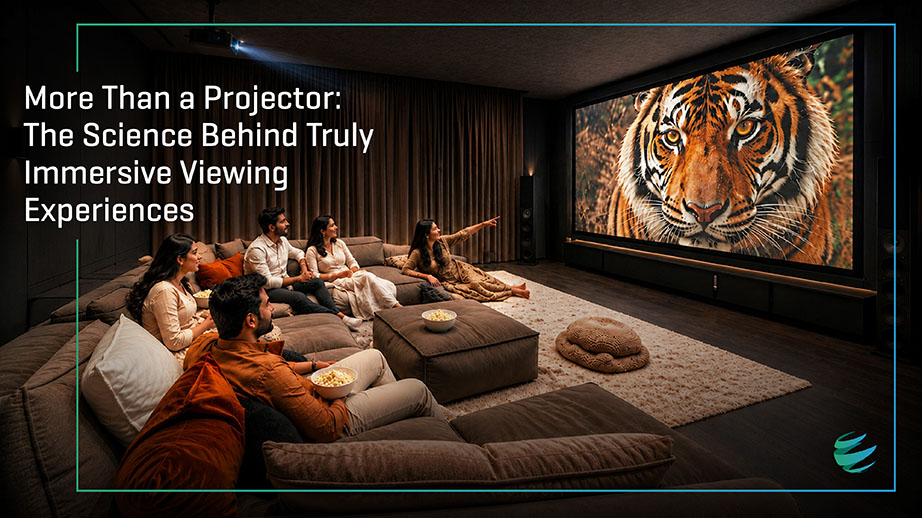
As projection technology continues to evolve, so do the expectations of viewers. From home theatres to professional AV environments, today’s audiences demand sharper visuals, richer colours, and consistent image quality across larger viewing formats. Meeting these expectations requires more than a high-performance projector—it requires a projection screen engineered to maximise every aspect of the visual experience.
For years, discussions around projection performance have centred on the projector itself—its brightness, resolution, and light source. While these advancements have significantly elevated visual experiences, they represent only one part of the equation. The projection screen plays an equally important role, determining how effectively light is reflected, colours are reproduced, and contrast is preserved.
Today, projection screens are no longer passive display surfaces. They are precision-engineered optical components that work in harmony with modern projection systems to deliver immersive, lifelike visuals. Understanding this synergy is key to creating exceptional viewing experiences across residential, commercial, and professional AV applications.
Beyond Brightness: Why the Screen Matters
When selecting a projector, brightness and resolution often become the primary decision-making factors. While these specifications are important, they represent only one half of the visual equation.
A projection screen is designed to control how light is reflected back to the viewer. Its surface characteristics directly influence image brightness, colour accuracy, contrast, and viewing consistency. A poorly matched screen can reduce the impact of even the most sophisticated projector, leading to washed-out colours, uneven illumination, and loss of detail.
The right screen, however, allows every lumen produced by the projector to be used efficiently, creating images that appear sharper, richer, and more natural.
The Science Behind Superior Image Performance
Modern projection screens are far more sophisticated than simple white surfaces. They are engineered using advanced screen surface technologies that optimise light reflection while maintaining image fidelity.
Several factors contribute to this performance:
Contrast Optimisation
Brightness attracts attention, but contrast creates depth. A high-performance screen helps preserve darker blacks while maintaining bright highlights, resulting in images with greater realism and visual impact.
Colour Accuracy
Professional screen surfaces are designed to reproduce colours faithfully without unwanted shifts or distortions. This ensures that movies, presentations, and digital content appear exactly as intended by their creators.
Viewing Uniformity
One of the defining characteristics of a premium projection screen is its ability to maintain consistent brightness and colour across the entire surface. Uniform light distribution eliminates hotspots and ensures every viewer enjoys the same exceptional image quality, regardless of where they are seated.
Surface Precision
As projectors continue to support 4K, 8K, and emerging display technologies, screen surface precision becomes increasingly important. Smooth, optically engineered surfaces preserve fine details and maximise image sharpness, allowing viewers to experience every texture and nuance.
Matching the Screen to the Environment
Every projection environment presents unique challenges. A home cinema requires deep contrast and cinematic colour reproduction, while a conference room may demand excellent performance under ambient lighting. Educational spaces prioritise readability from multiple viewing angles, and premium entertainment venues require exceptional image consistency across large-format displays.
Choosing the right projection screen is therefore not simply about selecting the correct size. It involves understanding how screen gain, surface technology, room lighting, and projector specifications work together to deliver the desired visual experience.
When these elements are properly matched, the result is a display system that performs at its full potential.
The Future of Immersive Viewing
As projection technology continues to evolve, screen innovation is advancing at the same pace. Modern screen materials are being developed to support laser projection, higher resolutions, enhanced colour performance, and greater viewing consistency.
The industry is moving beyond the pursuit of brightness alone. Today’s focus is on delivering complete visual performance—where every element, from projector to screen, contributes to a more immersive and engaging viewing experience.
This shift is redefining how projection systems are designed across residential, commercial, and professional AV applications.
Bringing Every Detail to Life
Exceptional projection is never the result of a single component. It is the outcome of a carefully engineered partnership between projector and screen.
While the projector generates the image, the projection screen determines how effectively that image is presented to the audience. By preserving contrast, maintaining colour accuracy, ensuring viewing uniformity, and optimising light performance, advanced screen technology unlocks the true capabilities of modern projection systems.
At Lumina Screens, we believe immersive viewing begins with the perfect balance of projection and screen engineering. Because extraordinary visual experiences aren’t created by brightness alone—they are created by how every detail, every colour, and every contrast is brought to life.
“An immersive viewing experience is created not just by the projector, but by how effectively the screen brings every detail, color, and contrast to life.”
Why is a projection screen important for image quality?
A projection screen is engineered to optimise light reflection, improving brightness, contrast, colour accuracy, and image uniformity. It helps a projector deliver its full visual potential.
Does a premium projection screen improve laser projector performance?
Yes. Premium projection screens are designed to complement laser projectors by preserving image detail, enhancing contrast, and maintaining consistent brightness across the viewing surface.
What factors should I consider when choosing a projection screen?
Consider projector type, room lighting, screen size, viewing angle, and the screen’s optical properties. Matching these factors ensures optimal visual performance.
What is viewing uniformity in projection screens?
Viewing uniformity refers to consistent brightness and colour reproduction across the entire screen, ensuring every viewer enjoys the same high-quality image regardless of seating position.
Why is screen surface technology important?
Screen surface technology determines how projected light is reflected, directly impacting contrast, colour fidelity, image sharpness, and overall viewing experience.
- Date - June 29, 2026