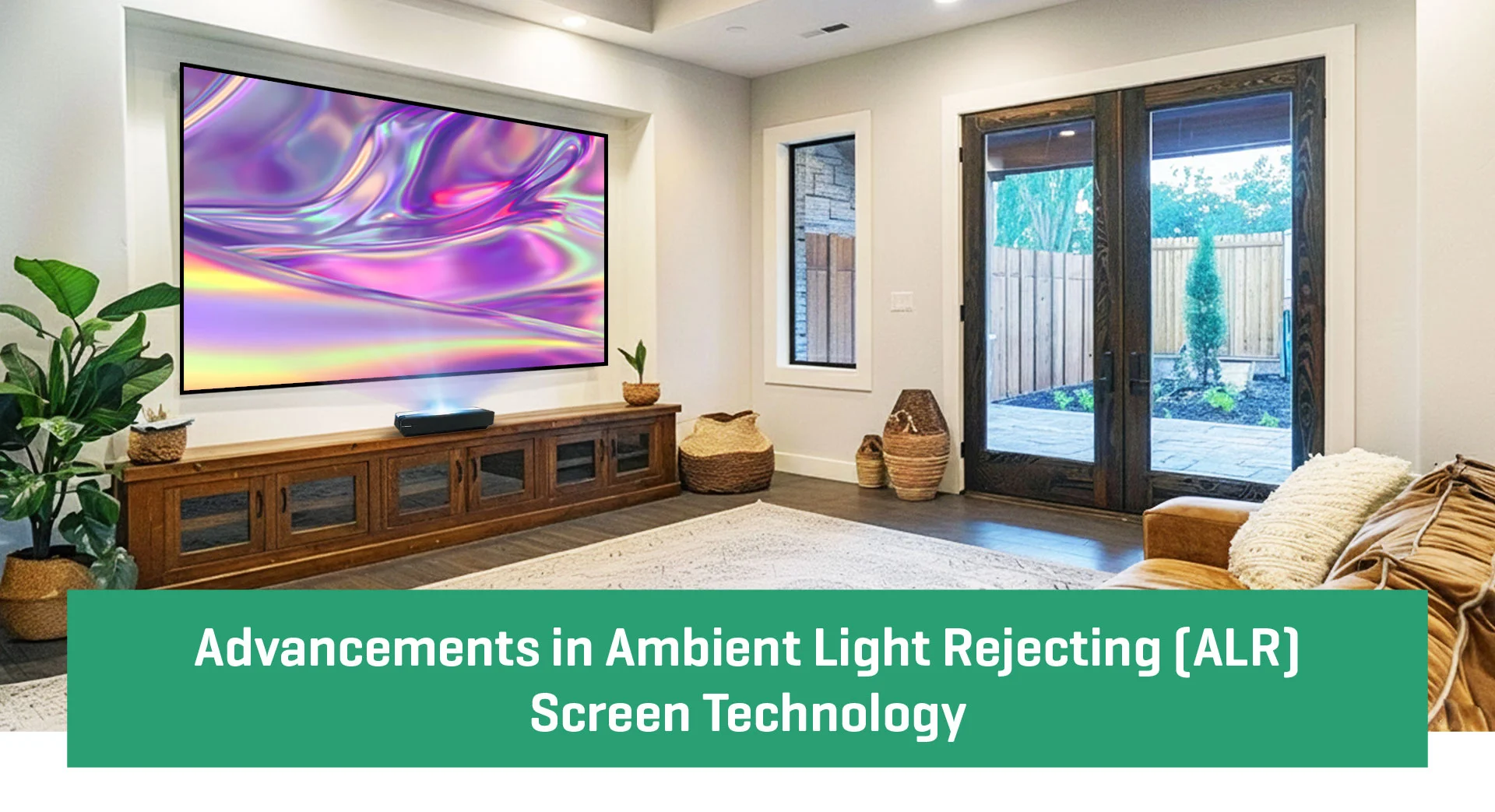
In modern projection environments, achieving high image clarity is no longer limited to dark rooms. As projectors become brighter and home theatre spaces become more flexible, Ambient Light Rejecting (ALR) screens have emerged as a breakthrough solution—allowing viewers to enjoy high-contrast visuals even in rooms with significant ambient light.
This article explores how ALR technology has evolved, how different materials compare, and where the future of ALR screens is heading.
1. Introduction to ALR Technology
Ambient Light Rejecting screens are engineered to control and direct light, enabling projected images to retain contrast and color accuracy even in brighter environments.
Unlike traditional white screens, which reflect light uniformly in all directions, ALR screens use specialized optical layers that:
- Accept light only from the projector
- Reject light coming from other angles, such as room lighting or sunlight
- Enhance perceived contrast and image sharpness
ALR screens are especially useful in multipurpose living rooms, media rooms, classrooms, and commercial AV setups where full darkness is not always possible.
2. Benefits of ALR Screens in Various Environments
ALR technology delivers advantages across a wide range of use cases:
✔ Home Theatres in Non-Dark Rooms
Not every home theatre is built in a fully light-controlled environment. ALR screens allow users to enjoy cinematic visuals in rooms with windows, lamps, or overhead lights—without washed-out images.
✔ Living Room / Media Room Setups
Many users now prefer placing projection screens in living rooms instead of creating dedicated dark rooms.
ALR screens help maintain deep blacks and vibrant colors even during daytime viewing.
✔ Corporate & Educational Spaces
In boardrooms and classrooms, it’s impractical to dim the lights completely.
ALR screens ensure visibility for everyone in the room, improving clarity during presentations and discussions.
✔ Gaming & High-Brightness Applications
Gamers benefit from ALR screens’ ability to preserve contrast and reduce glare—critical for fast, immersive visual performance.
✔ Better Contrast & Color Performance
By minimizing ambient washout, ALR screens significantly improve:
- Contrast levels
- Color saturation
- Depth of blacks
- Detail visibility
- HDR performance
This makes them ideal for high-lumen and high-resolution projectors.
3. Comparison of Leading ALR Screen Materials
ALR performance can vary widely depending on the material and optical structure. Here’s a comparison of the most common technologies:
1. Optical Layered ALR (Structured ALR)
These screens use a multi-layer optical structure with microscopic angles or lenticular patterns that selectively reflect projector light.
Pros:
- Excellent rejection of overhead lighting
- High contrast
- Suitable for brighter rooms
Cons:
- Can have limited viewing angles if poorly engineered
- Higher cost
2. Lenticular ALR Screens
Lenticular surfaces use vertically oriented ridges to reject horizontal ambient light.
Pros:
- Great for ultra-wide rooms
- Works well with short-throw projectors
Cons:
- More sensitive to installation angles
3. Retro Reflective ALR Screens
These screens reflect light back toward the source, improving brightness for viewers seated near the projector line.
Pros:
- High brightness
- Good for long-throw projectors
Cons:
- Not ideal for ultra-short throw setups
- Narrower viewing cone
4. Black or Dark Tint ALR Screens
Black-tinted materials help absorb stray light and improve contrast.
Pros:
- Improved black levels
- Good for multipurpose spaces
Cons:
- Usually require brighter projectors
Where Lumina Fits In
As India’s 1st and only AV screen manufacturing company, Lumina Screens engineers ALR materials with extremely tight optical tolerances. The Leor Series ALR is designed to deliver:
- High ambient light rejection
- Wide viewing angles
- Rich color uniformity
- Enhanced black depth
- Compatibility with both long-throw and UST projectors (model-specific)
These advancements ensure professional-grade performance for home theatres and AV installations.
4. Future Trends in ALR Technology
The ALR segment is rapidly evolving. Key innovations expected in the near future include:
✔ 1. Enhanced UST Compatibility
With UST projectors becoming mainstream, ALR screens will increasingly use UST-specific lenticular structures to improve focus uniformity and minimize hotspotting.
✔ 2. Wider Viewing Angles with Multi-Layer Optics
Next-gen ALR materials aim to combine high rejection capability with ultra-wide viewing cones—ideal for living rooms and larger gatherings.
✔ 3. Improved HDR & High-Brightness Performance
Future ALR screens will be optimized for high-contrast HDR content, supporting projectors with higher lumen output and wider color gamuts.
✔ 4. Integration with Acoustically Transparent Fabrics
Hybrid ALR + AT (acoustic transparency) materials will enable immersive sound placement behind the screen without compromising image quality.
✔ 5. Sustainability in Materials
Manufacturers are moving toward eco-friendly coatings and recyclable frameworks, supporting long-term environmental responsibility.
Conclusion
Ambient Light Rejecting screens have transformed how projection is enjoyed, making high-quality visuals possible in spaces far beyond traditional dark rooms. As ALR materials continue to evolve, viewers can expect richer contrast, better color accuracy, and greater installation flexibility.
With the Leor Series ALR, Lumina Screens brings these global advancements to India—delivering engineered precision, optical consistency, and a cinema-like experience in any environment.
Whether installed in a living room, home theatre, or professional AV setup, ALR screens are shaping the future of immersive viewing.
- Date - December 9, 2025