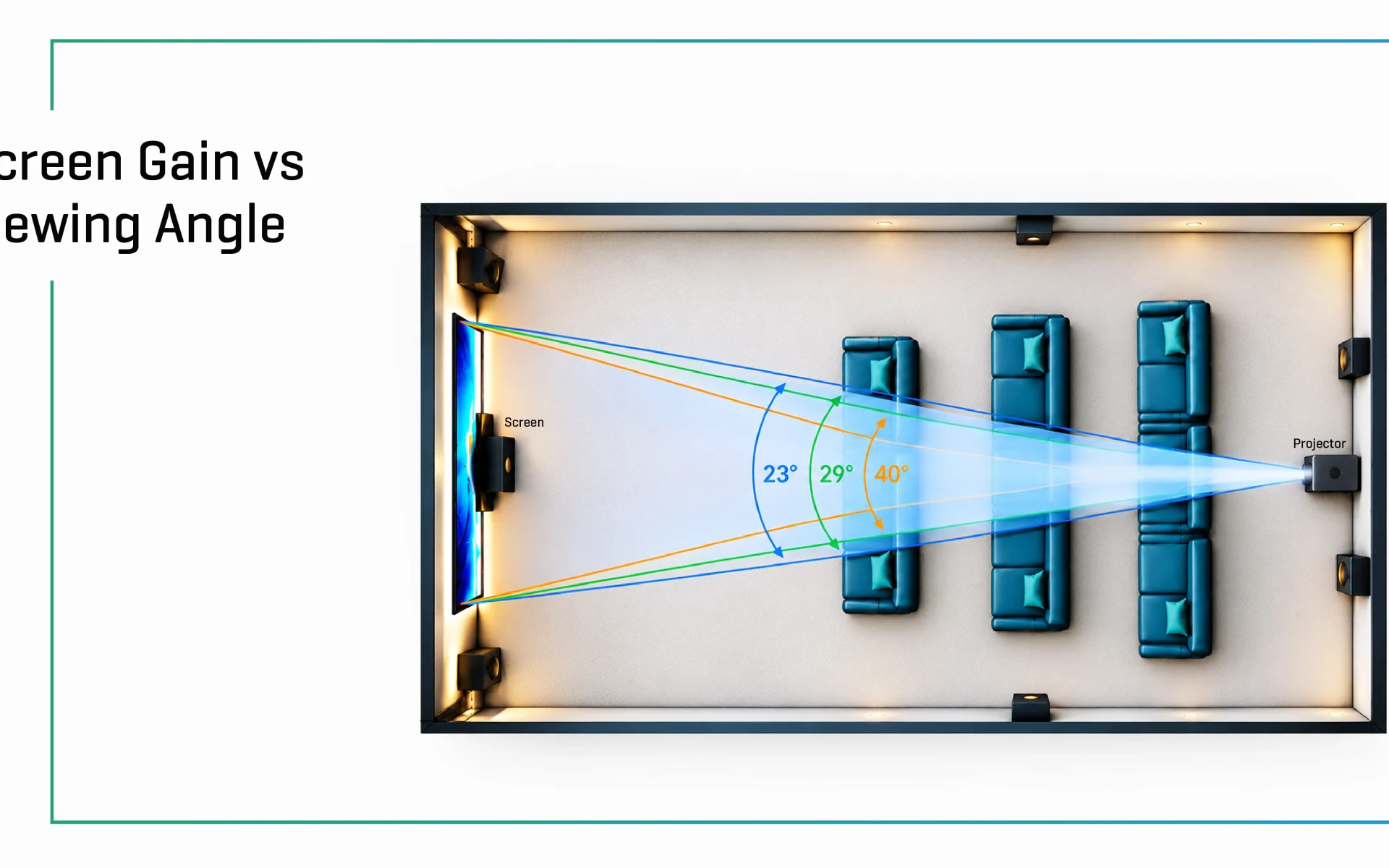
When choosing a projector screen, specifications such as screen gain, viewing angle, brightness, contrast and image uniformity can make the decision seem more complicated than it needs to be.
One specification may promise greater brightness, while another may offer a wider viewing angle. But what do these numbers actually mean, and how do they affect what you see on screen?
Understanding the relationship between screen gain and viewing angle is an important part of choosing the right projection screen for a home theatre, media room, boardroom or professional AV environment.
The key is not simply to look for the highest gain or the widest viewing angle. The right screen is one that balances these characteristics according to the projector, room, screen size, ambient light and seating arrangement.
What Is Screen Gain?
Screen gain describes how a projection screen reflects light toward the viewer compared with a standard reference surface.
A screen with a gain of 1.0 is generally considered a unity-gain reference. A surface with a gain higher than 1.0 is designed to provide greater reflected brightness in its intended viewing region, while a surface below 1.0 generally reflects less light toward the primary viewing direction.
Importantly, a screen does not create additional light.
Instead, the screen’s optical surface determines how the projector’s light is distributed after it reaches the screen.
This is why two screens with different gain values can produce noticeably different viewing experiences even when they are paired with the same projector.
What Is Viewing Angle?
The viewing angle describes the range over which viewers can move away from the centre viewing position while continuing to experience the projected image at an acceptable level of brightness.
One commonly used specification is the half-gain angle.
It refers to the angle at which the measured brightness falls to approximately half of the peak brightness measured along the screen’s primary viewing axis.
In simple terms, imagine sitting directly in front of the centre of the screen. As you move further to the side, the amount of reflected light reaching your eyes can change.
The optical characteristics of the screen surface determine how quickly that brightness changes.
Screen Gain vs Viewing Angle: What Is the Relationship?
This is where the subject becomes interesting.
Screen gain and viewing angle are related, but they are not simply opposite numbers.
The way a screen distributes reflected light depends on its optical construction.
A more directional screen surface can concentrate reflected light toward a particular viewing region. This can help increase perceived brightness for viewers within that region.
A more diffuse surface can distribute reflected light more broadly, which can help provide a more consistent viewing experience across a wider seating area.
Therefore, when comparing screens, it is important to look at gain and viewing angle together, rather than treating either specification as an independent measure of quality.
Does Higher Gain Always Mean a Narrower Viewing Angle?
No.
This is an important point when comparing projector screens.
It is common to hear that higher gain automatically means a narrower viewing angle. While more directional optical surfaces can exhibit this behaviour, gain alone does not determine viewing angle.
The optical design of the screen surface matters.
For example, Lumina’s own screen specifications demonstrate that different surfaces can achieve different combinations of gain and viewing characteristics. Splendora 1.4 is specified at 1.4 gain with a 65° half-gain angle, while Leor Black is specified at 0.8 gain with a 30° half-gain angle.
This is why comparing screens purely on the basis of their gain number can be misleading.
The better question is: how does the screen distribute light within the actual viewing environment?
High-Gain Screens: When Can They Be Useful?
Higher-gain projection surfaces can be useful when additional perceived brightness is desirable.
They may be considered for applications where:
- The screen is relatively large.
- Projector brightness needs to be used efficiently.
- Seating is concentrated within the screen’s intended viewing region.
- Brightness is an important priority.
- The room and projection geometry suit the screen’s optical characteristics.
However, the gain number should never be considered on its own.
A screen with a higher gain may have a particular light distribution pattern that affects brightness uniformity, seating flexibility and the overall viewing experience.
This is why professional screen selection involves more than simply choosing the highest gain available.
Wider Viewing Angles: Why Do They Matter?
A wider viewing angle can be particularly valuable when an audience is spread across a room.
Consider a home theatre with several rows of seats.
Viewers sitting directly in front of the screen may experience the image differently from viewers seated significantly to the left or right, depending on the screen surface.
For a wider seating arrangement, a screen that provides consistent image performance across a broad viewing area can be more important than maximum brightness from one central position.
This is especially relevant for:
- Home theatres
- Media rooms
- Boardrooms
- Training rooms
- Classrooms
- Auditoriums
- Multipurpose AV spaces
The wider and more varied the seating arrangement, the more carefully viewing angle should be considered.
Why Screen Gain Is Only One Part of Image Brightness
The brightness you perceive on screen is influenced by more than screen gain.
Other important factors include:
Projector brightness
The projector’s light output has a direct impact on the amount of light available to illuminate the screen.
Screen size
As the projected image becomes larger, the projector’s available light is spread across a greater area.
Throw distance
The distance and geometry between the projector and screen influence how the projection system performs.
Room lighting
Ambient light can reduce perceived contrast and affect image quality, particularly in rooms that are not fully controlled for light.
Screen surface
Different screen materials distribute projected light differently and can affect brightness, contrast, colour reproduction and uniformity.
Seating arrangement
The position of the audience determines how important viewing angle becomes.
This is why screen gain should always be evaluated as part of the complete projection system.
Screen Gain, Viewing Angle and Image Uniformity
Another important consideration is image uniformity.
A projection screen should ideally provide a consistent image across the viewing area.
If the optical behaviour of a surface causes significant variation in brightness depending on where the viewer sits, the experience can become less consistent.
This is particularly noticeable in large rooms or wide seating arrangements.
For a home theatre, for example, you may want viewers sitting in the front row, centre seats and side seats to experience a similar image.
That makes the relationship between gain, viewing angle and uniformity an important part of screen selection.
What About ALR Projection Screens?
The conversation becomes even more important when choosing an Ambient Light Rejecting (ALR) screen.
ALR screens are designed to manage the interaction between projected light and ambient light using specialised optical surfaces.
Rather than simply reflecting all incoming light equally, an ALR surface is designed to control light distribution according to its optical characteristics.
This can make ALR screens particularly useful in environments where controlling ambient light completely is difficult.
However, ALR performance is highly dependent on the screen’s optical design, projector placement, ambient-light direction and viewer position.
Therefore, the viewing angle remains an important specification when selecting an ALR screen.
Screen Gain vs Viewing Angle for Home Theatre
For a dedicated home theatre, the right balance depends on the room.
Small, centrally seated audience
If most viewers sit close to the centre of the screen, a screen designed to prioritise brightness within that viewing region may be suitable.
Wide seating arrangement
If viewers are spread significantly across the room, viewing angle and brightness consistency become increasingly important.
Controlled lighting
A dark, dedicated theatre provides greater flexibility because ambient light has less influence on perceived contrast.
Multipurpose room
A room used for movies, gaming, presentations and other activities may require a more versatile screen solution.
There is no single gain value that is universally best.
How to Choose the Right Projector Screen
Before selecting a screen, consider these five questions.
1. How bright is the projector?
A high-output projector may not require a highly directional screen surface to achieve the desired brightness.
2. How large is the screen?
Larger screens distribute the projector’s available light across a greater surface area, making screen characteristics more important.
3. Where will viewers sit?
A narrow seating arrangement and a wide seating arrangement can have very different screen requirements.
4. How much ambient light is present?
A dedicated theatre and a naturally lit living room require different approaches to screen selection.
5. What matters most to the viewing experience?
Is your priority maximum brightness, wide viewing flexibility, contrast, image uniformity, colour performance—or a balance of all of them?
Answering these questions can help narrow down the right screen technology.
Gain Is Not a Quality Score
One of the biggest mistakes when comparing projector screens is treating gain like a simple quality rating.
For example:
- 1.5 gain does not automatically mean better performance than 1.0 gain.
- A higher gain may be advantageous in one installation and unnecessary—or less suitable—in another.
- A wider viewing angle does not automatically mean a better screen for every application.
The right choice depends on how the screen is going to be used.
A professional projection screen should be selected based on the complete optical performance of the surface, not a single specification.
The Right Balance Makes the Difference
The relationship between screen gain and viewing angle ultimately comes down to how projected light is distributed.
A screen surface can be engineered to manage light in different ways depending on the intended application.
That means the right projection screen should provide an appropriate balance of:
- Brightness
- Viewing angle
- Image uniformity
- Contrast
- Colour performance
- Ambient-light management
- Seating flexibility
The best screen isn’t necessarily the one with the highest gain. It is the one that works best with the projector, room and audience.
Choosing a Lumina Screen
Lumina Screens offers a range of projection surfaces designed for different viewing environments and performance requirements.
From ALR solutions designed for environments with ambient light to projection surfaces designed to deliver brightness and image performance in controlled environments, selecting the right surface begins with understanding the installation.
Lumina’s product range includes the Leor Series, Accupix Series, Splendora 1.4 and Color Pro White, allowing screen selection to be matched more closely to the intended application.
For example, Lumina’s technical specifications demonstrate how different screen surfaces can offer different combinations of gain, ambient-light performance and viewing characteristics.
The objective is not simply to maximise one specification. It is to create a projection experience that looks consistent, immersive and natural from the intended viewing positions.
Explore the Lumina Screens range to learn more about the available projection solutions, or contact the Lumina team for guidance on choosing the right screen for your installation.
Final Takeaway
Screen gain and viewing angle should always be considered together.
Gain tells you about the screen’s light-reflection characteristics, while viewing angle helps indicate how that reflected light is experienced from different positions.
But neither number should be treated as a standalone measure of screen quality.
The right projection screen depends on the relationship between the projector, screen size, screen surface, room lighting, seating arrangement and viewing requirements.
So, when comparing projection screens, don’t just ask:
“Which screen has the highest gain?”
Ask:
“Which screen provides the right balance of brightness, viewing angle and image uniformity for my space?”
Because a great projection experience isn’t about making the image brightest from one seat. It’s about making the image look right from where people actually watch it.
Frequently Asked Questions
Q: What is screen gain in a projector screen?
Screen gain indicates how a projection screen reflects light toward the viewer compared with a standard reference surface. It helps describe the screen’s light-reflection characteristics.
Q: Is higher screen gain better?
Not necessarily. Higher gain can be useful when greater perceived brightness is required, but the ideal gain depends on projector brightness, screen size, room conditions, seating arrangement and the optical design of the screen.
Q: What is viewing angle in a projection screen?
Viewing angle describes how far viewers can move away from the central viewing position while maintaining the intended level of image brightness and performance.
Q: What is a half-gain angle?
The half-gain angle is the viewing angle at which measured screen brightness falls to approximately half of its peak value from the primary viewing axis.
Q: Does higher gain always reduce viewing angle?
No. Gain and viewing angle are influenced by the optical design of the screen surface. They should be evaluated together rather than assuming that one specification automatically determines the other.
Q: Is viewing angle important for a home theatre?
Yes. Viewing angle becomes particularly important when the audience is spread across multiple seats or rows. A suitable screen should provide an appropriate viewing experience across the intended seating area.
Q: Are ALR screens suitable for rooms with ambient light?
ALR screens are specifically designed to manage ambient light through specialised optical surfaces. However, performance depends on factors such as the screen technology, projector position, ambient-light direction and viewer position.
Q: How do I choose the right screen gain?
Start with the projector’s brightness, screen size, room lighting and seating arrangement. Then evaluate screen gain, viewing angle, contrast and image uniformity together to determine the most suitable screen surface.
- Date - October 13, 2026