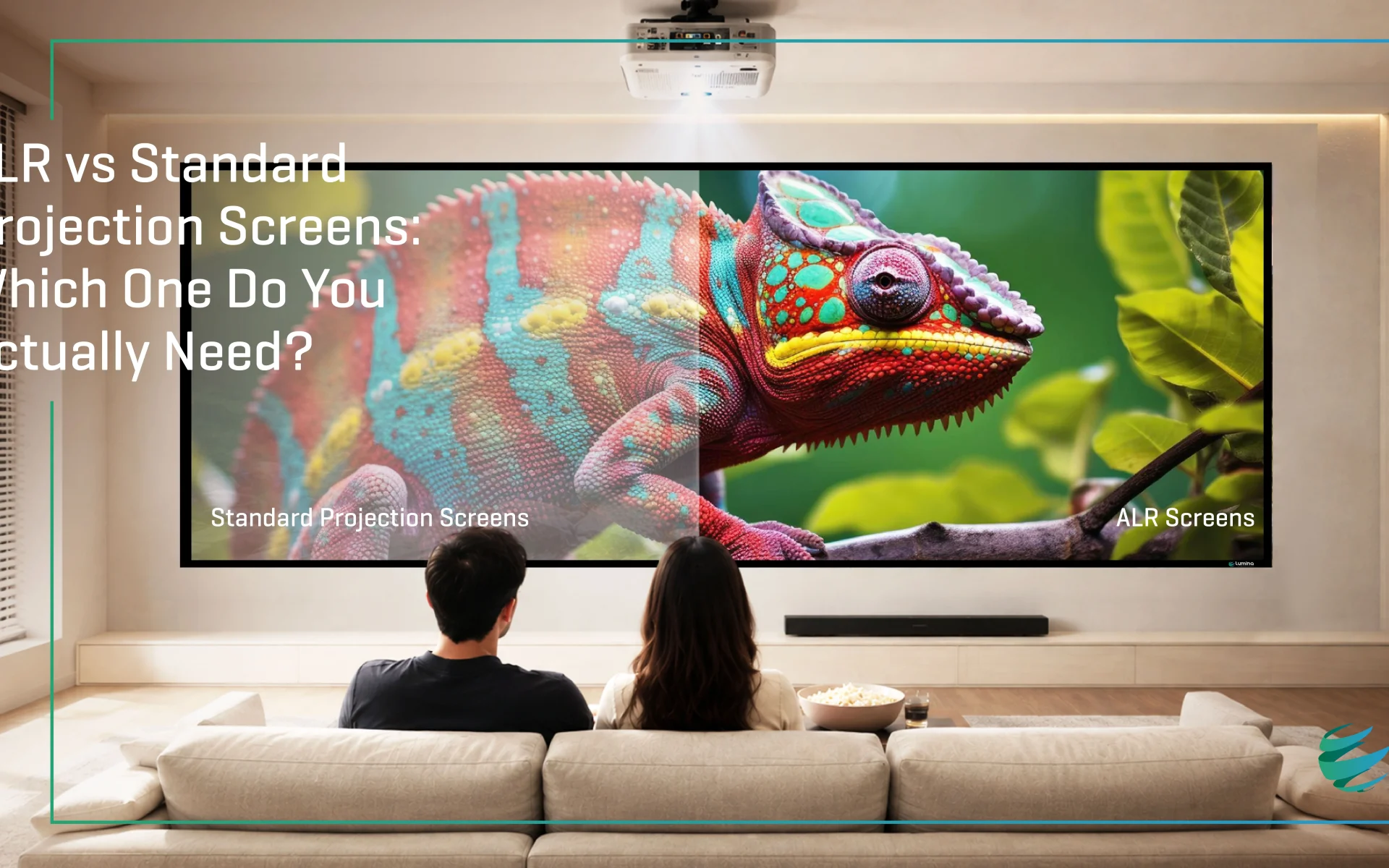
You’ve picked your projector. Now you’re looking at projection screens and wondering: do you actually need an Ambient Light Rejecting (ALR) screen, or will a standard surface do the job? Here’s the honest answer — and how to decide for your room.
Most people spend weeks comparing projectors. Then they buy whatever screen is cheapest or most convenient.
That’s a mistake — because the screen determines how your projector’s output actually lands. It affects colour accuracy, contrast, brightness uniformity, and how the image holds up when there’s even a little ambient light in the room.
Standard screens and ALR screens are not interchangeable. They’re engineered for different environments. Using the wrong one doesn’t just limit your picture — it actively works against it.
This guide explains exactly what ALR technology does, how it compares to a standard matte white screen, and which type is right for which room.
What Is a Standard Projection Screen?
A standard projection screen — also called a matte white screen — reflects light in all directions equally. It has a gain rating close to 1.0, which means it reflects approximately the same amount of light that hits it, spread across a wide viewing angle.
This makes it an excellent surface in one specific condition: a fully darkened room with no ambient light sources.
How It Works
The surface is designed to diffuse reflected light uniformly. Wherever you’re sitting in the room — centre, side, back — you get a similar image brightness. There’s no hotspot, no colour shift at angles, and the image holds excellent uniformity.
Where It Performs Well
• Dedicated home theatre rooms with full blackout treatment
• Basement cinemas with no windows
• Commercial cinema environments with controlled lighting
• Setups where the projector is powerful enough that brightness is not a constraint
Where It Fails
In any room with ambient light — a window, a ceiling downlight, a hallway — a standard screen becomes a liability. It reflects ambient light back at the viewer just as readily as it reflects the projected image. The result is a washed-out picture with crushed blacks and flattened contrast.
⚠️ The key limitation of a standard screen:
It cannot distinguish between projected light and ambient light. It reflects both equally — which is exactly the problem.
What Is an Ambient Light Rejecting (ALR) Screen?
An Ambient Light Rejecting screen is engineered to do something a standard screen cannot: selectively reflect projected light while rejecting ambient light coming from other angles.
This is achieved through the surface’s micro-structure — either a retro-reflective optical coating or a precision angular weave that controls which direction of incoming light gets reflected back toward the viewer.
How It Works
Projected light arrives at a specific angle from the projector (typically from in front of or below the screen). The ALR surface’s optical structure is engineered to reflect that angle of incidence directly back toward the viewing zone.
Ambient light — from windows, ceiling fixtures, and room lighting — arrives at different angles (overhead or from the sides). The ALR surface’s structure causes it to scatter or absorb these instead of reflecting them toward the viewer.
The result: the projected image is reinforced, while ambient light interference is significantly reduced.
Types of ALR Surfaces
Angular / Optical Coating ALR
Uses a retro-reflective coating layered over the screen surface. Reflects light back toward the source angle very efficiently. Works best with ceiling-mounted projectors (light arrives from above-centre).
Lenticular / Woven ALR
Uses a precision-woven or micro-structured surface with angled elements that direct reflected light toward the seating zone. Works across a wider range of projector placements.
UST ALR
Designed specifically for ultra-short throw projectors, which project from below or very close to the screen. The surface is optimised for this extreme angle of incidence — a standard ALR will not perform correctly with UST projectors.
💡 Key insight:
ALR screens are not just ‘better’ screens. They’re specialised screens. Their advantage is specifically in rooms with ambient light. In a perfectly dark room, a high-quality standard surface can outperform a low-end ALR.
ALR vs Standard Screen: Side-by-Side Comparison
Here’s how the two surface types compare across the factors that matter most for real-world home theatre setups:
|
Factor |
Standard (Matte White) |
ALR Screen |
|
Ambient light performance |
Poor — reflects all light sources equally |
Excellent — rejects off-axis ambient light |
|
Dark room performance |
Excellent — wide angle, accurate colour |
Good to excellent (depends on quality) |
|
Viewing angle |
Very wide (160°+) |
Moderate to wide (depending on type) |
|
Gain range |
1.0 (neutral) |
0.8–1.5 (varies by product) |
|
Colour accuracy |
Excellent (neutral surface) |
Very good (slight variance by product) |
|
UST compatibility |
Not compatible |
UST-specific variants required |
|
Price point |
Lower |
Higher — premium technology |
|
Best use case |
Dark, controlled room |
Any room with ambient light |
When Do You Actually Need ALR?
This is where most buyers get confused. The marketing around ALR screens can make it sound like everyone needs one. The reality is more specific.
You Need an ALR Screen If…
• Your viewing room has windows — even with curtains, diffused light enters during daytime viewing
• You have recessed downlights or ceiling fixtures that can’t be turned off completely
• You watch content in the evenings but don’t want to fully darken the room
• Your room is multipurpose — used as both a living space and a viewing space
• You’re using a laser projector with moderate lumens (under 3,000) in a non-dedicated room
• You want to maintain good image quality without blackout treatment
A Standard Screen Is Fine If…
• You have a dedicated home theatre room with full blackout treatment
• You only watch content in complete darkness
• Your room has no windows, or windows with total blackout blinds
• You have a very high-lumen projector (4,000+ lumens) and a controlled room
• Budget is a constraint and you have full control over room lighting
📐 The simple test:
Turn off every light in your room at midday. If the room is not completely dark, you need ALR.
The UST Exception
If you’re using an ultra-short throw projector — placed directly below or at the base of the screen — a standard ALR will not work correctly. The optical geometry of most ALR surfaces is designed for a projector placed several feet away, at an angle that puts it roughly in line with the viewer’s eye level.
UST projectors project from a completely different angle. You need a UST-specific ALR surface, which has its micro-structure engineered for this angle of incidence. Using a standard or conventional ALR with a UST projector typically produces brightness non-uniformity and distorted colour.
Lumina ALR Screens: Which Surface for Which Room?
Lumina manufactures a range of ALR and standard surfaces, each engineered for a specific use case. Here’s how to map your room type to the right Lumina screen:
|
Room Type |
Lumina Surface |
Why |
|
Living room with ambient light |
1.5 gain ALR — bright image, rejects ceiling and side light, wide viewing angle for sofa seating |
|
|
Living room, very bright daytime use |
Higher gain ALR for rooms with significant ambient light — punchy image in challenging conditions |
|
|
Living room with UST projector |
Engineered specifically for ultra-short throw angle — essential for UST setups |
|
|
Dedicated dark theatre room |
1.2 gain for wide-angle accuracy; Leor Black for maximum contrast in sealed dark rooms |
|
|
Dedicated theatre with in-wall speakers |
Acoustically transparent ALR — speakers behind screen, no audio-visual compromise |
|
|
Semi-controlled media room |
Choose 1.2 for controlled rooms, 1.5 if ambient light is present or windows are hard to treat |
|
|
Entry-level / budget home setup |
Standard matte surface — excellent value for dark rooms or nighttime viewing |
All Lumina surfaces are manufactured at our facility in Mumbai. Datasheets, gain ratings, and technical specifications are available at luminascreens.com.
Common Mistakes When Choosing Between ALR and Standard
Mistake 1: Buying an ALR Screen for a Dark Room
ALR technology is designed to handle ambient light. In a fully dark room, its optical structure isn’t adding value — and a lower-quality ALR surface can actually introduce slight colour shifts or reduce the wide-angle uniformity of a good matte white. If your room is truly dark, don’t overpay for ALR.
Mistake 2: Using a Standard Screen in a Semi-Lit Room
The most common error. ‘It looks fine’ — until you try to watch on a bright afternoon, or someone leaves a ceiling light on. A standard screen in a room with any ambient light will disappoint you every time.
Mistake 3: Using a Standard ALR with a UST Projector
This will produce a non-uniform image — typically brighter at the bottom where the projector throws light, darker at the top. UST projectors require UST-specific ALR. This is not a minor difference — it’s a fundamental optical mismatch.
Mistake 4: Choosing Gain Without Considering Seating Width
High-gain ALR surfaces (1.6+) deliver brightness by narrowing the viewing cone. If you have a wide sofa or multiple seating positions spread across the room, a high-gain surface will look significantly dimmer at the edges. For wide seating arrangements, choose 1.2–1.5 gain.
Mistake 5: Ignoring the Projector’s Lumen Output
ALR screens don’t make a dim projector bright. A 2,000-lumen projector in a bright room still won’t perform well even with an excellent ALR surface. ALR rejects ambient light — but the projected image still needs adequate brightness to begin with. For rooms with significant ambient light, pair ALR with at least 3,000–4,000 lumens.
FAQ: ALR vs Standard Screens
Q: Is an ALR screen worth the extra cost?
For any room that isn’t completely dark during viewing, yes. The image quality difference between a standard screen and an ALR screen in a normally lit living room is substantial — not marginal. If you’re investing in a quality projector, an ALR surface protects that investment.
Q: Can I use an ALR screen in a dark room?
Yes, but you may not need to. A good quality ALR screen performs well in dark rooms, but so does a high-quality standard matte surface — often at lower cost. If your room is fully blacked out, a standard screen is a rational choice. If you think you might ever watch with ambient light present, the ALR is the safer investment.
Q: Do ALR screens work with all projectors?
Standard and conventional ALR screens work with long-throw and short-throw projectors. Ultra-short throw projectors (UST) require UST-specific ALR screens — the optical geometry is fundamentally different. Always confirm UST compatibility before purchasing if you’re using a UST projector.
- Date - September 17, 2026